
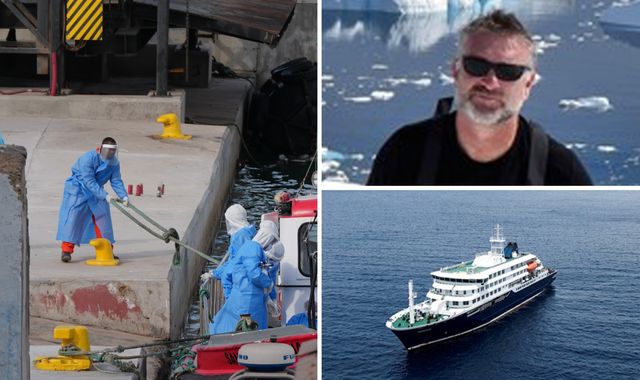
Martin Anstee, an expedition guide on board the MV Hondius, was one of three people evacuated from the vessel on Wednesday.
Follow latest on outbreak and get in touch
The 56-year-old was taken to a hospital in the Netherlands, where he said he was “doing okay” but that “there are still lots of tests to be done”.
Mr Anstee, a retired police officer and avid wildlife photographer, told Sky News: “I have no idea how long I’ll be in the hospital for.
“I’m in isolation at the moment.”
Regarding his symptoms, Mr Anstee said he could not say anything further at the moment but added that doctors “should have a clearer picture” later this week.
Three people have so far died after cases of the virus – which is typically spread by rodents when particles from their droppings, saliva and urine become airborne – were detected on board the Dutch-flagged cruise ship.
The World Health Organization (WHO) said on Wednesday that the number of confirmed hantavirus cases has now risen to five.
Meanwhile, two people who were on board the ship have since returned independently to the UK and are self-isolating, although neither are showing symptoms, the UK Health Security Agency (UKHSA) said.
Another Briton is currently in hospital in South Africa.
‘Not the next COVID’
Following the evacuation of Mr Anstee, alongside his Dutch colleague and a German passenger on Wednesday, the MV Hondius departed from the Cape Verde capital Praia, where it had been anchored, and is now en route to the Canary Islands.
The journey is set to take three to four days, and, once it arrives at its destination, the ship’s remaining passengers and crew – around 140 people – will be moved off the vessel.
Read more from Sky News:
What is hantavirus and why is it so deadly?
Parents told to check children’s handwashing
A spokesperson for the UKHSA said that a period of “up to eight weeks” of isolation may be required after exposure to the virus – although they acknowledged that this was the “most cautious scenario” and could be changed later on.
The public health body added that the risk to the public “remains very low”.
Maria Van Kerkhove, an epidemiologist at the WHO, played down concerns about hantavirus, insisting the outbreak is “not the next COVID”.
Officials investigating the hantavirus outbreak told the Associated Press that a couple’s birdwatching trip while in Argentina may explain how the virus got onto the ship.
The officials anonymously told the news agency that they believe the pair could have contracted the virus after being exposed to infected rodents while birdwatching at a landfill site in Ushuaia, the world’s southernmost city.