
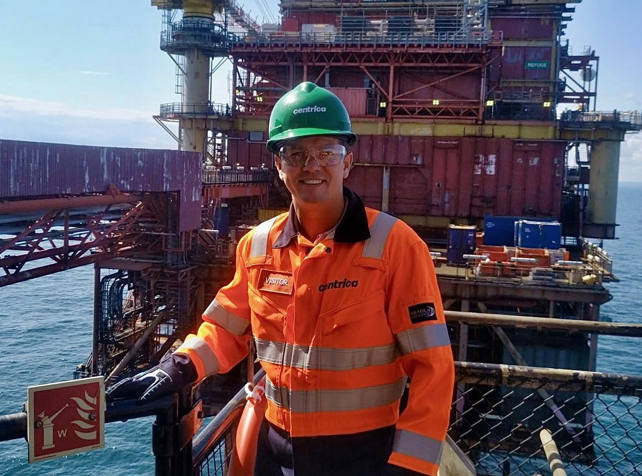
The Mayor of Hull and East Yorkshire is urging the government to decide the future of the North Sea Rough gas storage facility before a rapidly-approaching April 2027 deadline. Luke Campbell is ringing alarm bells for policymakers, as the East Yorkshire facility’s urgent need for investment risks closing off a ‘nationally important energy option’.
The proposed £2 billion investment in Rough, which is about 18 miles off the East Yorkshire Coast, would support almost 5,000 roles during construction and roughly 640 full-time equivalent jobs over the lifetime of the project, according to an academic analysis. And the investment would come at a critical time, with household energy bills rising ever higher.
Rough provides half of Britain’s gas storage capacity. Allowing it to close in April 2027 would leave the UK with less than six days of gas reserves during an international supply crunch.
Some policymakers argue this makes it a critical public utility that deserves state support. Others are warning its decommissioning could be ‘irreversible’ and lead to a permanent crisis in gas supply.
But energy insiders are said to be concerned that Centrica, which runs the gas storage and the connected onshore Easington Gas Terminal in East Yorkshire, is asking for too much from government. And there are worries that its proposed model could potentially expect the general public to underwrite commercial gas market volatility or fund legacy North Sea asset maintenance under the guise of energy security.
Hull and East Yorkshire is powering the country.
Any decision needs to be made quickly, argues Mayor Campbell. He has now written to the Secretary of State for Energy Security and Net Zero after visiting the Rough facility off the East Yorkshire coast and meeting the Centrica team responsible for the site.
He said: “I’m not asking Government to sign off Centrica’s preferred model without scrutiny. Value for money and consumer protection matter. I’m asking Government to make the decision while there is still a decision to make.
“Hull and East Yorkshire already helps power the country. If this investment stacks up nationally, I want the jobs, skills and supply-chain benefits that come with it to be felt here too.”
The right investment in the site could mean the Humber region becoming only more important in the nation’s energy security at a time of global instability.
Mayor Campbell added: “Rough is bigger than one company or one site. It is part of Britain’s energy security and it sits just off our coast.
“I’ve been offshore, I’ve seen the scale of it and I’ve spoken to the people who keep it running. There are skilled jobs here, a Humber supply chain and a company saying it is prepared to put around £2billion into the future of the site.”
Mayor Campbell’s letter asks the Secretary of State to confirm the timetable for the government’s decision on the future commercial framework for gas storage and whether any interim action is available, if needed, to stop Rough being irreversibly lost before that work is complete.
He has also offered to bring Centrica and relevant Humber partners together immediately if further evidence or regional coordination would help.
Government decisions are urgently needed
The current production and storage licence expires in April 2027. Without an explicit licence renewal and environmental consent from the government, Centrica cannot legally continue operating the field.
But Centrica has previously said that it will not apply to extend its licence past April 2027 unless the UK government agrees to a long-term state support mechanism.
A September article in the national media from Centrica’s CEO, Chris O’Shea, stated: “Without energy there is no economy; without energy security there can be no national security. When governments think about national security, they plan for threats before they materialise, investing in capabilities we may not need daily but which become critical when a crisis hits. Energy security deserves the same approach.”
The energy chief believes that the last five years of security crises in Ukraine and the Middle East have triggered damaging energy shocks, disrupted gas supplies and put pressure on global energy markets.
“International co-operation cannot always be relied upon to find a solution. Every country will put the security of its own citizens first,” he stated.
“As North Sea production has declined by 70 per cent, reliance on imports has grown. Yet our gas storage lags behind Germany, France and the Netherlands, which have around ten times more capacity than the UK.
“This winter will be more concerning. EU gas stocks are at the lowest levels since records began, increasing exposure to supply shocks and price volatility. The UK is even more exposed. As one of Europe’s biggest gas consumers, but with some of its lowest storage capacity, we rely on expensive imported gas to heat homes and keep the lights on.”
Rough, in the North Sea, is the UK’s only large-scale gas storage facility. Yet it is practically empty, as markets currently do not make it financially viable, according to Centrica.
Mr O’Shea explained: “Storage is an insurance policy against supply disruption and price spikes. But if the government chooses not to include Rough in its existing regulatory support model, it will remain empty over the winter and close by the spring, losing hundreds of unionised, well-paid jobs.
“The government’s interim consultation on the future of gas accepts that the market is unlikely to support storage on a purely commercial basis. But we need action now. With the right framework, we can invest £2billion to preserve one of the UK’s most important energy resilience assets. This is not simply a commercial decision for Centrica; it is a strategic decision for the country. But we are running out of time.”
A delay could make decommissioning ‘irreversible’
Hull and East Yorkshire Combined Authority (HEYCA) is warning that Rough’s current consent expires on 30 April 2027 and that ‘it does not currently intend to seek an extension without enough certainty over the future commercial framework’.
If operations end and decommissioning follows, the company says the decision could become irreversible before government has completed its wider work on gas storage.
HEYCA’s Local Growth Plan makes clear an ambition to connect Hull and East Yorkshire’s nationally important strengths in energy, ports, logistics and manufacturing to more private investment. Local policymakers hope it will build stronger local supply chains and deliver good jobs.
A Department for Energy Security and Net Zero spokesperson made clear that although gas storage is an important part of the UK’s energy system, it’s just one part.
She said that the UK’s varied sources of gas supply means that the countryis far less reliant on gas storage than some European countries who have larger storage capacities to mitigate their lack of diverse supply.
“UK gas supply is diverse and highly resilient. Gas storage was only 5% of our supply last winter,” the spokesperson said.
“We have plans in place to maintain our energy security, whilst ensuring value for money for consumers and continuing the transition to clean power.”
She added that the government is still exploring commercial support for the sector, including storage operators, to help protect the UK’s gas security amd the department is engaging with the gas storage sector to demonstrate value for money for UK taxpayers.
Trade unionists are now pushing for public ownership of the facility
The trade untion Unite have made clear that Rough can be part of the UK’s transition to net zero and have backed the idea to adapt the site to store hydrogen rather than natural gas.
Unite national officer for energy Simon Coop said public ownership of the site should be on table. “Rough is a part of the UK’s critical infrastructure and is vital to energy security supply,” he said.
“Therefore, the government needs to work with all parties to secure the future of Rough. If that is not possible then Unite will push for the government to keep the site open at all costs including the option of public ownership.”
Unite’s general secretary Sharon Graham is concerned the UK has the lowest level of gas storage in recent history. She added: “Threats of closure are endangering jobs and our ability to keep the lights on and heat homes.
“The general public will not forgive the government or Centrica if this facility is allowed to close and our energy supply becomes even more risky in an increasing uncertain world.”
Creating a Humber energy sector for the future
Rough is the UK’s only large-scale gas storage site and has 54 billion cubic feet of capacity, around half of Britain’s total gas storage capacity. It has not been refilled this summer and is currently producing a limited amount of native gas rather than operating as a storage site.
Centrica claim a fully stocked UK storage system, including Rough, would equate to around 12 days of gas demand, compared with around six days without Rough. The company says a full redevelopment could increase Rough’s capacity to around 260 billion cubic feet – around 30 days of gas – while retaining the potential for the reservoir to store hydrogen in future.
Business leaders and politicians gathered in Hull last month to share the blueprint for the Humber Hydrogen project, which would further boost the region’s critical role in the nation’s energy infrastructure. The huge hydrogen project could deliver 700 apprenticeships and safeguard around 4,000 jobs in the the Humber region.
Centrica have previously shared plans to transform Rough’s gas storage, outlining the site’s potential to be used as part of the ambitious hydrogen scheme.
By: Paul Drury-Bradey, LDRS